Your surgeon told you to wear compression. They were right, and they meant it. What they usually don't have time for — in the fifteen minutes of a post-op check with a full waiting room — is the practical layer underneath the instruction: which garment, at which stage, fitted how, replaced when. So clients fill the gap with size charts, forum threads, and guesswork, and then they come to us with a garment that's quietly working against them.
Juanita's rule, formed across 15+ years of post-op work alongside Los Angeles surgeons: the garment matters as much as the massage. Here's the missing briefing.
What compression is actually for
After lipo, a tummy tuck, or a BBL, the space where fat used to be doesn't close on its own timeline — it closes on the timeline your body is given. Even, consistent pressure supports the tissue while swelling comes down, gives returning fluid fewer places to sit, and helps the skin redrape smoothly against its new contour. That's the whole job: even and consistent. Every fit problem you'll ever have with a garment is a failure of one of those two words.
Compression doesn't sculpt you, and it doesn't do the lymphatic system's work for it. What it does is hold the ground between sessions — which is why we treat the garment and the drainage work as one system, not two purchases.
Stages, in plain terms
Post-surgical compression comes in stages because your body changes faster than any single garment can follow.
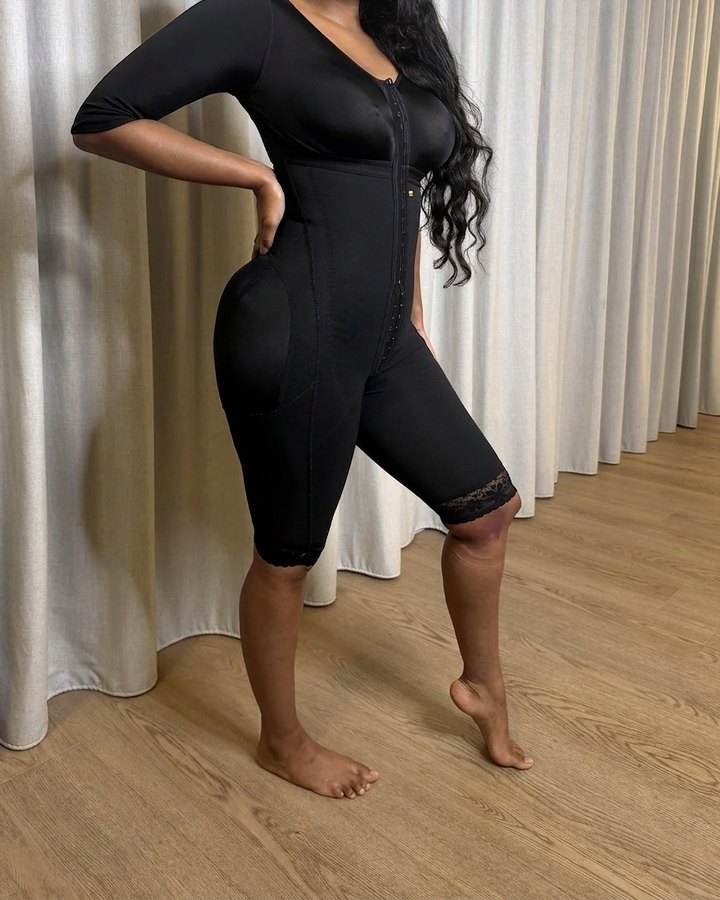
- Stage one is the early garment — gentler, gradual compression, often with closures that accommodate dressings and the dramatic swings of the first weeks. Many surgeons provide it or specify it; it goes on while everything is still at its most swollen.
- Stage two arrives when the early swelling has meaningfully dropped — typically somewhere in the weeks after surgery, on your surgeon's schedule, not the calendar's. It's firmer, cut closer, and does the longer work of supporting the tissue as your result settles in.
- The transition is a fit event, not a date. When your stage-one garment starts gapping, wrinkling, or needing constant adjustment, it's telling you it has finished its job. Every body and every surgeon is different — we follow your surgeon's instructions and adjust on intake, every time.
The mistakes we fix most
- Too loose. The most common one, and the sneakiest — a loose garment feels fine. But uneven, interrupted pressure lets fluid pool in the gaps, and pooled fluid is exactly what the garment exists to prevent.
- Bought by size chart alone. Post-surgical bodies don't match their pre-surgical measurements, and they change weekly. A garment ordered online to your old size is a coin flip.
- The rolling waistband. A rolled band isn't a nuisance — it's a pressure line where compression doubles, right where it shouldn't. Usually a cut or size problem, occasionally a "how it's being put on" problem. Both fixable.
- Skipping the wear schedule. Whatever hours your surgeon prescribed — day, night, or both — that's the number. Garments only do their work while they're on.
- Staying in stage one too long. Attachment to the comfortable garment is real. So is the fluid that a spent garment stops managing.
- Digging, marking, or numbness. Deep marks at the edges, tingling, or numbness are not "high compression working" — they're a fit problem, and anything beyond a fit problem is a question for your surgeon that day, not a thing to push through.
How we handle it in-studio
We fit and sell CYSM Colombian compression garments in-studio — by your size, by your stage, and by the procedure you had. Fittings are by appointment only, pricing varies by garment and size and is confirmed at your fitting, and we carry men's compression as well. Because the fitting happens on your actual post-op body, on the day you're actually in, the size-chart coin flip disappears — and if you arrive for a drainage session in a garment that isn't doing its job, we'll tell you, and we'll fix it while you're on the schedule anyway.
There's a geography advantage too. The studio sits on the Wilshire corridor in Beverly Hills, within a mile of the surgery centers many post-op schedules already orbit — so for most of our clients, a fitting stacks onto a follow-up day or a drainage session instead of becoming its own errand across Los Angeles. Out-of-town clients recovering nearby before flying home use this constantly: one short trip, three boxes checked.