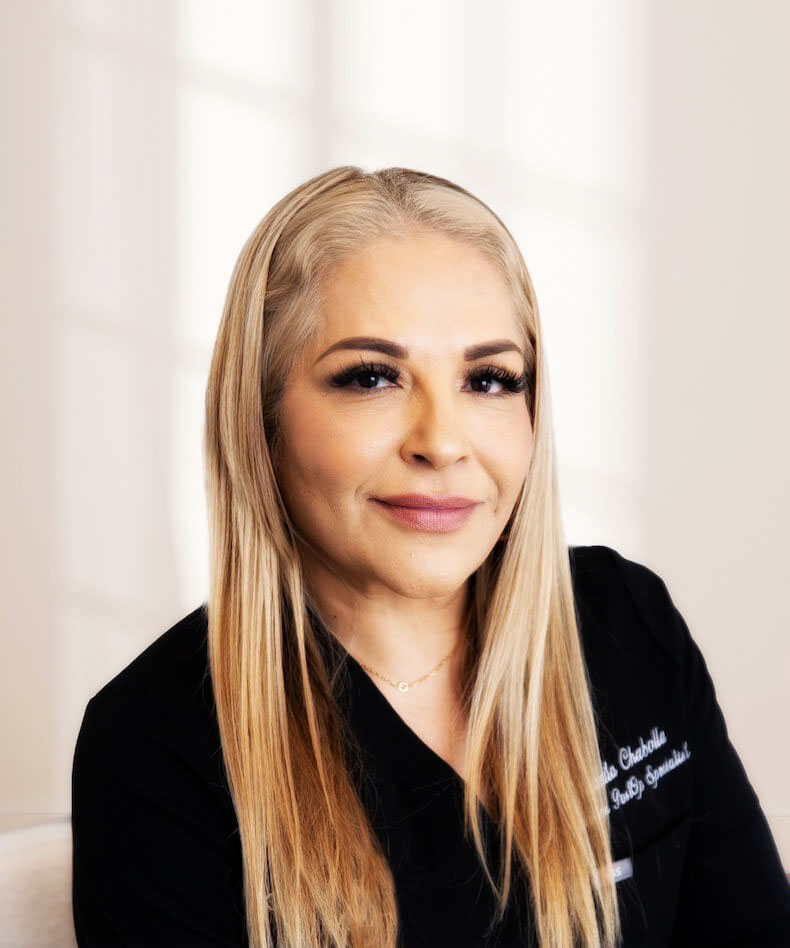

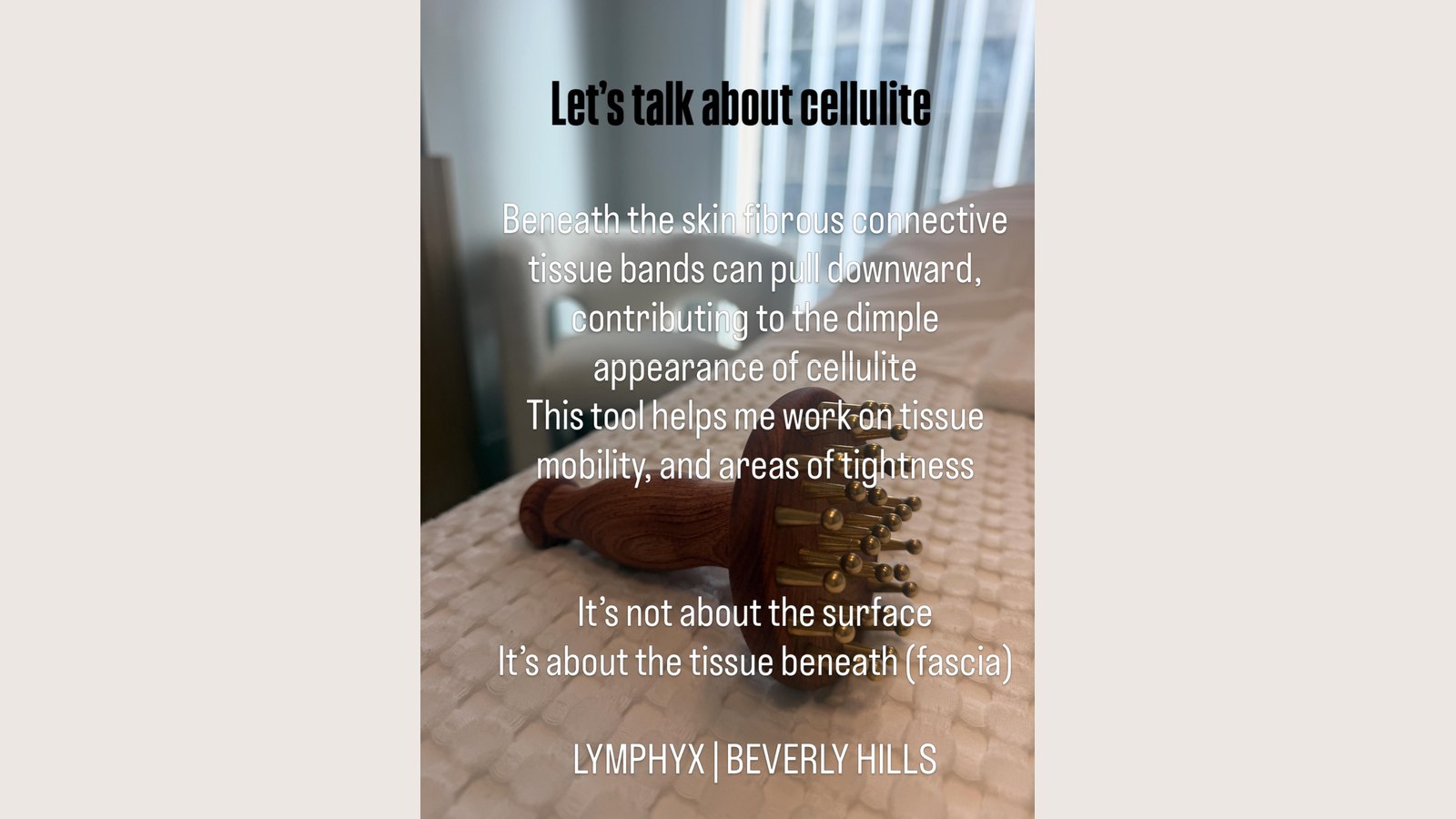
Cellulite is the dimpled surface that appears when fibrous connective-tissue bands beneath the skin pull downward while the fat between them pushes upward. Hands-on body sculpting can temporarily change how that surface looks. It does not change the bands themselves, and nothing done by hand removes cellulite for good. That is the honest version, and it is the one Juanita Chabolla, licensed massage therapist and founder of Lymphyx in Beverly Hills, put on the studio's Instagram last week over a photograph of the wooden tool she uses: "It's not about the surface. It's about the tissue beneath." This is the longer version — what the dimples are, what the published anatomy says, what a session on Wilshire Boulevard actually does, and what it will never promise.
What is actually happening beneath a dimple?
Skin is not laid loosely over fat. Between the dermis and the deeper fascia runs a network of fibrous bands — the septa — that tether the skin down, and the fat of the superficial layer sits in lobules between those bands. Where a band holds the skin firmly in place and the lobule beside it pushes outward, the surface puckers: a dimple here, a bulge there, the uneven texture most people recognise as cellulite. A 2020 review in Dermatologic Surgery describes exactly this architecture — fat lobules bulging between the fibrous septae that connect skin to the underlying fascia (Rudolph and colleagues, 2020). The newer anatomy adds a detail worth knowing: the subdermal network is three-dimensional, a mesh of septa and retinacula rather than a set of straight anchors, which may be part of why cellulite presents so differently from one region of the body to another and between the sexes (Journal of Cosmetic Dermatology, 2022).
Juanita's caption said the same thing in plainer words: "Beneath the surface, fibrous connective tissue bands anchor the skin to deeper layers. When these bands pull downward while surrounding fat pushes upward, they create the uneven texture we recognize as cellulite." The layer she is describing is fascia, and it is the reason a skin cream aimed at the surface is aiming at the wrong depth.
Can massage or wood therapy get rid of cellulite?
No — not permanently, and we would rather say so here than let a package say it for us. People search "does wood therapy work for cellulite" and "can fascia massage reduce cellulite" and land on pages that answer with a before-and-after photo. The published answer is narrower and more useful. Manual body-sculpting work acts at the surface of this tissue and can temporarily change how the topography looks; it does not alter the underlying septal and fat-lobule structure (Rudolph, 2020; Friedmann and colleagues, 2017). The bands are still there when the session ends. What changes is the state of the tissue around them — how mobile it is, how tight the band-bound areas feel, how much fluid is sitting in the lobules — and that is a real, visible, temporary change. The 2017 review is, tellingly, about subcision, the procedure that cuts the bands; it belongs to a physician's office, not a massage table, and we do not do it.
What a body sculpting session at Lymphyx actually does
The Body Sculpting session combines three things: wood therapy — firm, slow strokes with hand-carved wooden tools — for the surface, ultrasonic cavitation for the deeper tissue, and a lymphatic massage to finish, moving what the work releases. Sixty minutes is $250; ninety minutes is $330 and extends the wood-therapy portion. It is used to refine the waist, hips, abdomen and outer thighs over a series of weekly visits, and it is work, not rest: the pressure is deeper and the rhythm slower than a relaxation massage.
Where cellulite is concerned, the focus is the one Juanita named in the post — tissue mobility, areas of tightness, and circulation — "to help temporarily improve the appearance of cellulite." The tool in the photograph is for that: "This tool helps me work on tissue mobility, and areas of tightness." The lymphatic finish is not decoration. Wood therapy and lymphatic drainage help move retained fluid out of the area being worked, which is part of why a change can show quickly — and part of why it is fluid leaving, not fat, as the studio has said about every one of its sessions. Expect some bruising, especially from the wooden tools; it is a normal response to firm tissue work, it is not painful afterward, and it fades over a few days.
Two things the session will not do. It is not weight loss — the scale is not the point, and nobody here will tell you it is. And it will not hold on its own: the smoother, more defined look is real but temporary, and it lasts as long as the cadence lasts. Most clients who keep a result stay on a twice-monthly maintenance rhythm once the first eight weeks are done.
Is this still "wood therapy for cellulite"?
Not as a separate booking. Lymphyx retired the standalone wood-therapy session in September 2026. Wood therapy continues only as a modality inside Body Sculpting — the opening portion of every session, extended in the ninety-minute version — rather than as its own menu item, add-on or price. If you arrived here from a search for the old page, that is where it went, and the work itself is the same hands and the same tools.
Who should book it, and who should wait
Anyone not recovering from surgery can book directly. If you are post-operative, the surgeon's plan decides: body sculpting can be integrated from week six with your surgeon's clearance, and before that it is drainage only, because the tissue is not ready for direct, firm work. Dimpling that is new, painful, one-sided, or changing quickly is a reason to see a physician first; a session here is the appointment after that one, not instead of it.
Before you book in Beverly Hills
Sessions are one client at a time at 9150 Wilshire Boulevard in central Beverly Hills, an easy reach from West Hollywood and Century City and across the LA Westside. Hydrate well in the twenty-four hours before, eat lightly an hour before, wear two-piece clothing, skip spray tan for a day, and photograph the area beforehand — the studio asks every body sculpting client to do that, because a weekly photograph is how a temporary result gets judged honestly instead of remembered generously. Every session is performed by Juanita Chabolla, LMT: Vodder-method trained in manual lymphatic drainage, California CAMTC #82919, National Holistic Institute certified, working in Beverly Hills since 2018, in English and Spanish. Body Sculpting sits inside the studio's aesthetic menu beside the detox-and-debloat and colon-cleanse sessions, and like all of them it is priced on the page.