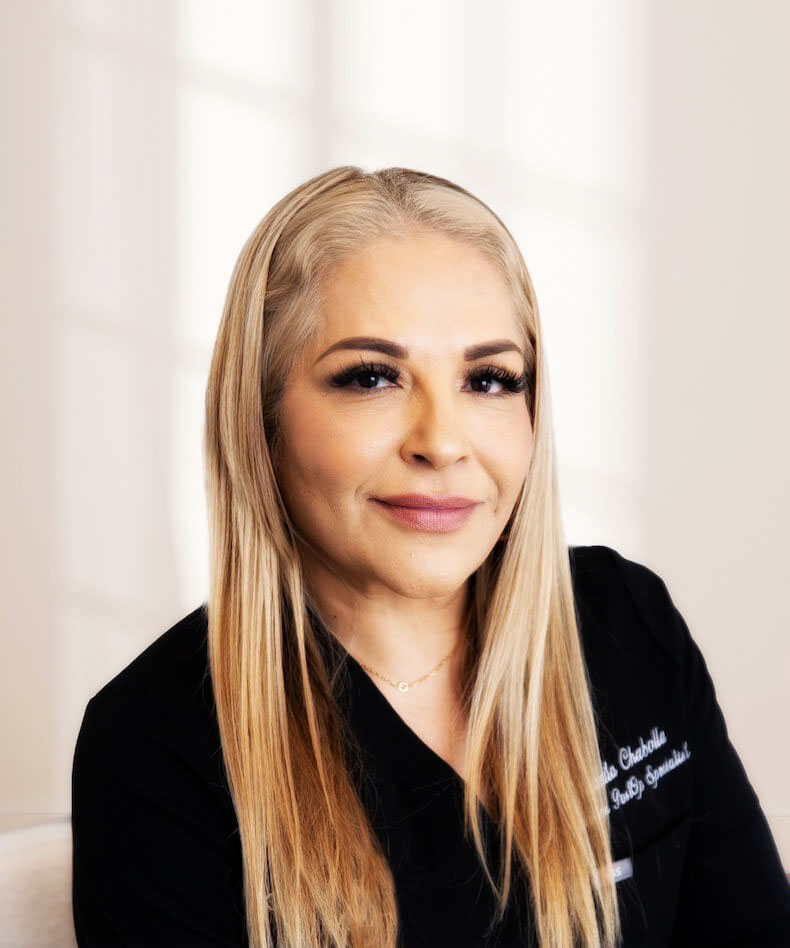
On the days a healthy body feels heavy — legs that are full by the evening, a waistband that is tighter at night than it was in the morning, a face that reads puffy — what has usually changed is fluid, not weight. A lymphatic drainage session at Lymphyx in Beverly Hills moves that fluid along the body's own return route. It does not move muscular tension, it does not flush toxins, and it is not a remedy for anything. Juanita Chabolla, licensed massage therapist and founder of Lymphyx, runs the sixty-minute wellness session (from $225) on Wilshire Boulevard, and this is the plain version of what the reel's caption was pointing at.
The caption read: "Your body holds onto more than you realize — tension, stress, fluid, inflammation." That is a good list, and an honest post has to take it one word at a time, because the session does different things with each of them.
What is the heaviness made of?
Fluid. Your circulation leaves fluid behind in the tissue all day, and the lymphatic system is the slow return line that collects it and carries it back toward the bloodstream. When the return runs slower than the day's inputs, the tissue holds more than it did the day before. One of those inputs has a well-described mechanism: dietary sodium is tightly linked to the body's water balance, and a rise in salt intake is followed by water held in the fluid around the cells rather than being fully cleared by the kidneys (Curr Opin Nephrol Hypertens, 2014; Proc Natl Acad Sci USA, 1996). That is why a salty dinner can leave you feeling fuller and heavier the next morning with no change in body fat at all. The days clients tell us about — the long flight, the desk day that ran late, the week before a period — are the days they describe the same feeling, and we take them at their word; we are not going to dress up a client's description as a research finding.
Tension. Tension is muscular. It sits in the back, the shoulders, the neck, and it is not fluid, which means it is not what drainage moves. If the heaviness you mean is the kind that needs working out, the session for chronic tension patterns is deep tissue, and flowing full-body work for stress and circulation is Swedish. We will tell you so when you book, and the studio offers all three, so you are not pushed into the wrong one.
Stress. Lymphatic work is slow and light by definition — closer to a metronome than to anything you would call a massage in the ordinary sense. Clients who expect the intensity of a sports session are surprised to find themselves half-asleep within ten minutes. That downshift is not a claim about treating stress. It is an hour in which nothing is asked of the body, and for a lot of our monthly regulars that hour is half the point.
Inflammation. This is the one word on the caption's list we leave to physicians. An hour of light strokes is not a remedy for inflammation, and we do not pretend otherwise. If swelling is new, unexplained, or sits in one leg and not the other, that is a question for your doctor before it is an appointment with us — we are the appointment after that one, not instead of it.
Where does the fluid sit?
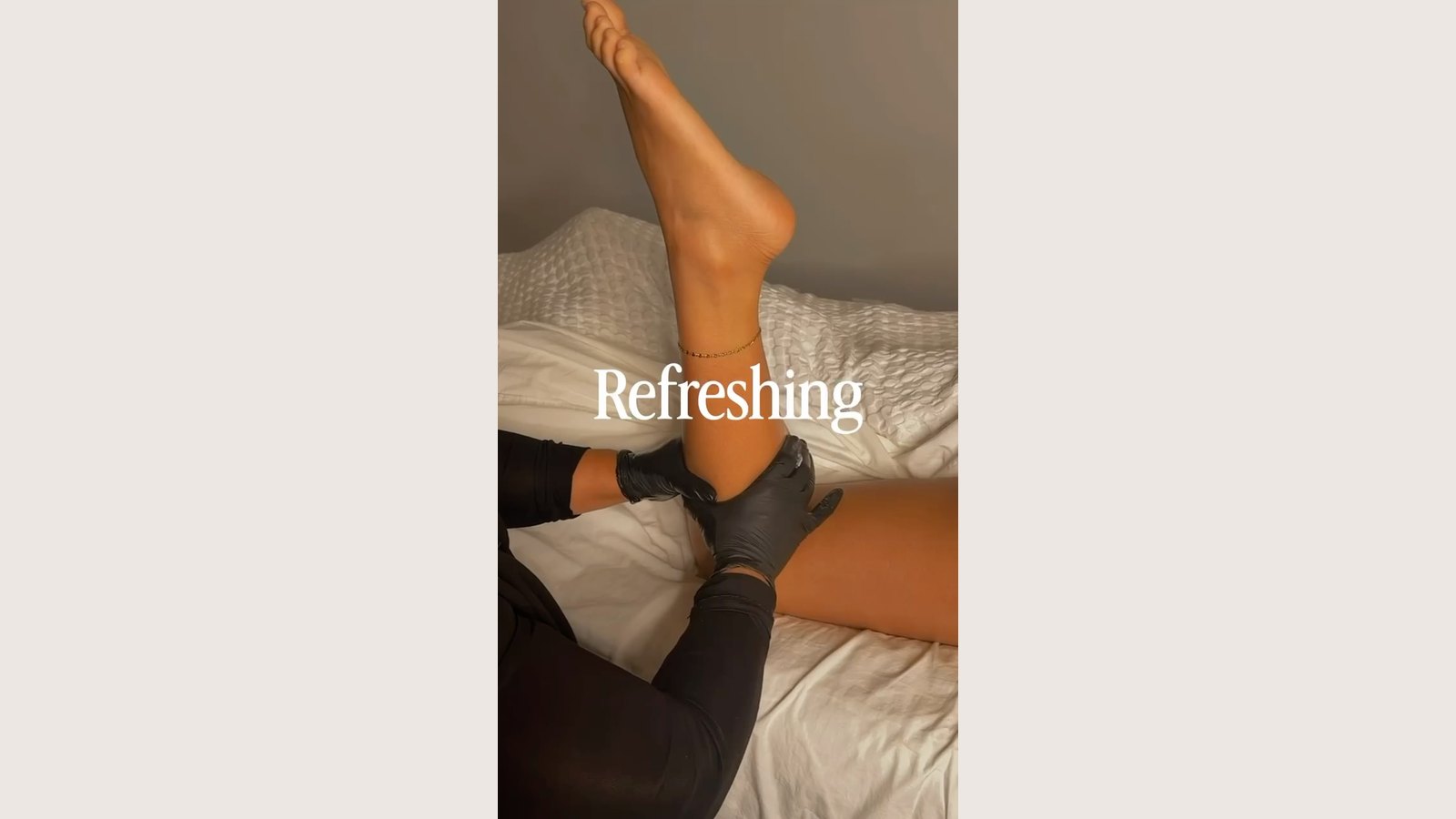
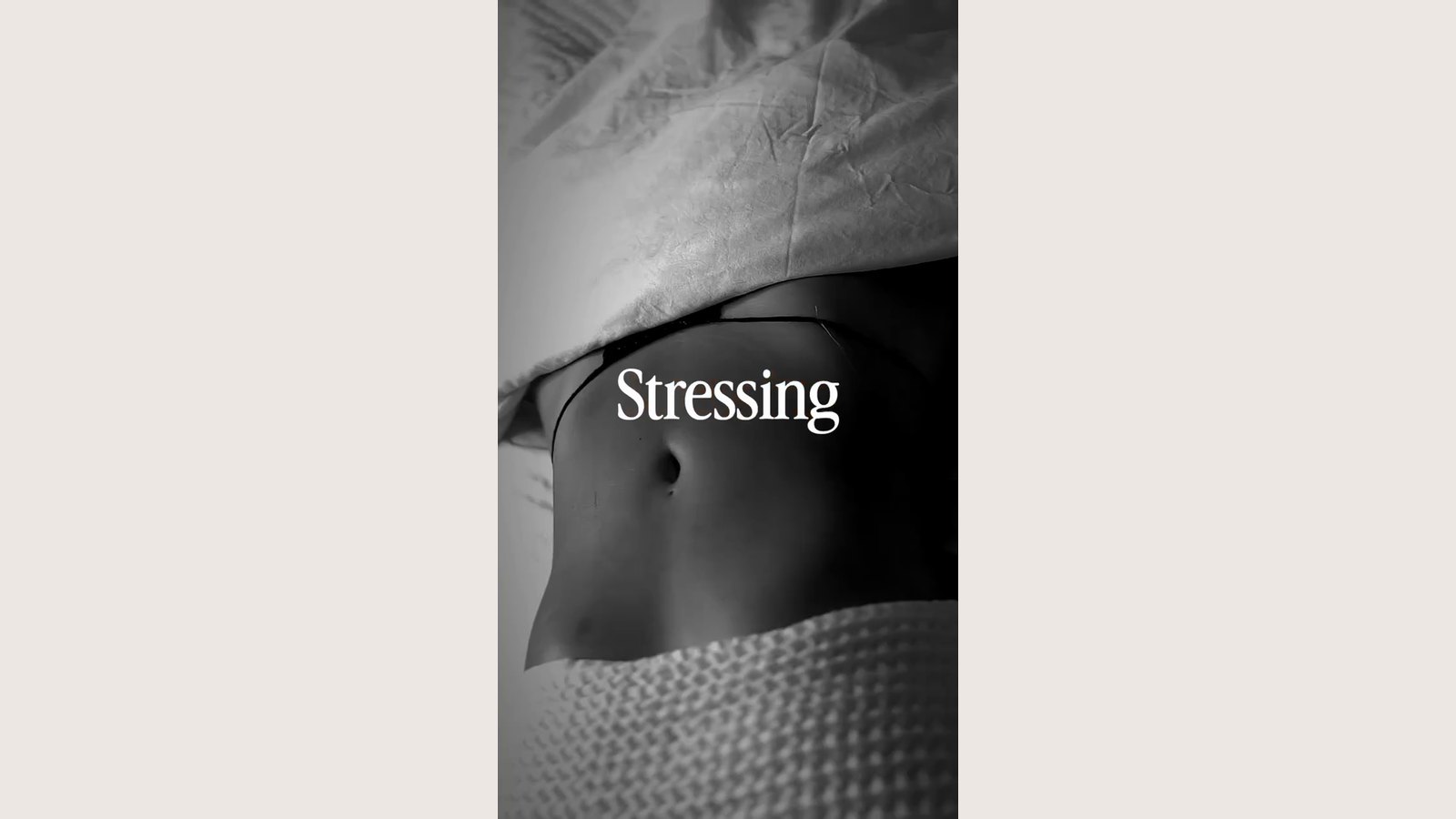
In the low points, mostly. The service page lists the places clients notice it — face, abdomen, ankles — and the reel walks through them in ten seconds. The cover frame is the ankle, because that is where a day on your feet or at a desk ends up by evening and where shoes are tighter at the end of a flight than at the start. The abdomen holds fluid and gas through the day, which is what bloat usually is — trapped fluid and gas, not fat — and why the midsection reads tighter at night. The face is where a short night or a salty dinner shows first.
The back is the exception, and the reel is honest about it: the word over that frame is "exhausting," not "swollen." What feels heavy across the back and shoulders is usually tension, and the strokes you see there are long and flat, moving fluid toward the junctions near the armpits rather than kneading muscle. Every session opens at the collarbones and works the trunk before the limbs, because the collarbones are where lymph re-enters the bloodstream; the ankle in the cover frame is one of the last places the hands go, not the first.
What does a session actually move?
Fluid, and only fluid. The lighter, de-puffed feeling clients describe on the way out has a plain explanation: fluid that was sitting in the tissue got moved along. The research on how lymph moves is more interesting than the usual "it has no pump" line — lymph is carried by outside forces, skeletal muscle and the pressure changes of breathing, and by the vessels themselves, whose segments between the valves contract on their own and squeeze lymph forward (Scallan and colleagues, J Physiol, 2016; Am J Physiol Heart Circ Physiol, 2007). A session that follows the direction the fluid already travels is working with something the body is already doing, slowly.
What to expect afterward is stated on the lymphatic massage service page before you book, and we would rather repeat it here than have you find out on the table: what leaves is retained fluid — typically one to three pounds of it — not fat, and it returns within a week or two; the de-puffed look holds for roughly seven to ten days; expect more trips to the bathroom for six to twelve hours. Those are the practice's own published expectations from years of sessions, not figures from a study, and we say so. The effect is temporary by design, which is the whole argument for a monthly rhythm rather than a one-off.
What it will not do
- It will not flush toxins. Your liver and kidneys do that around the clock without anyone's hands. "Detox" is a word we use carefully; what drainage moves is fluid.
- It will not change your shape. The slimmer look after a session is fluid leaving, not fat. Anyone selling it as sculpting is selling a different service.
- It will not work out tension. That is deep tissue or Swedish, booked as such.
- It is not a remedy for inflammation or any condition. New or unexplained swelling goes to your physician first. If you are recovering from surgery, your surgeon's plan decides when drainage begins and how it is done, and that path starts at post-operative care, not here. If you are pregnant, sessions are available after the first trimester with your OB's clearance.
What the reel shows
Ten seconds, in the studio, with a client who agreed to be filmed. The sheet stays on and the gloves go on before the first stroke. Then, one word per frame: the ankle and lower leg ("refreshing"), the hip under the edge of the sheet ("discharging"), long flat strokes across the back ("exhausting"), the raised arm and the junction near the armpit, with a towel over the eyes ("draining"), and the abdomen between sheet and towel ("stressing"). Five regions where heaviness is felt; one kind of thing being moved.
 ▶ Watch the reel
Booking a heavy day in Beverly Hills
The wellness session is the same protocol we use post-operatively, without an operative note to honor, so the whole body is available — sixty, ninety, or one-hundred-twenty minutes, one client at a time, at 9150 Wilshire Boulevard in central Beverly Hills. Most of our regulars are Beverly Hills, West Hollywood, and Century City people whose session slots into a workday, with the rest driving in from across the Westside of Los Angeles. Come in after the flight, the late desk day, or the salty week, and leave knowing exactly what moved and what did not. That is the only version of "feel lighter" we are willing to put in writing.