
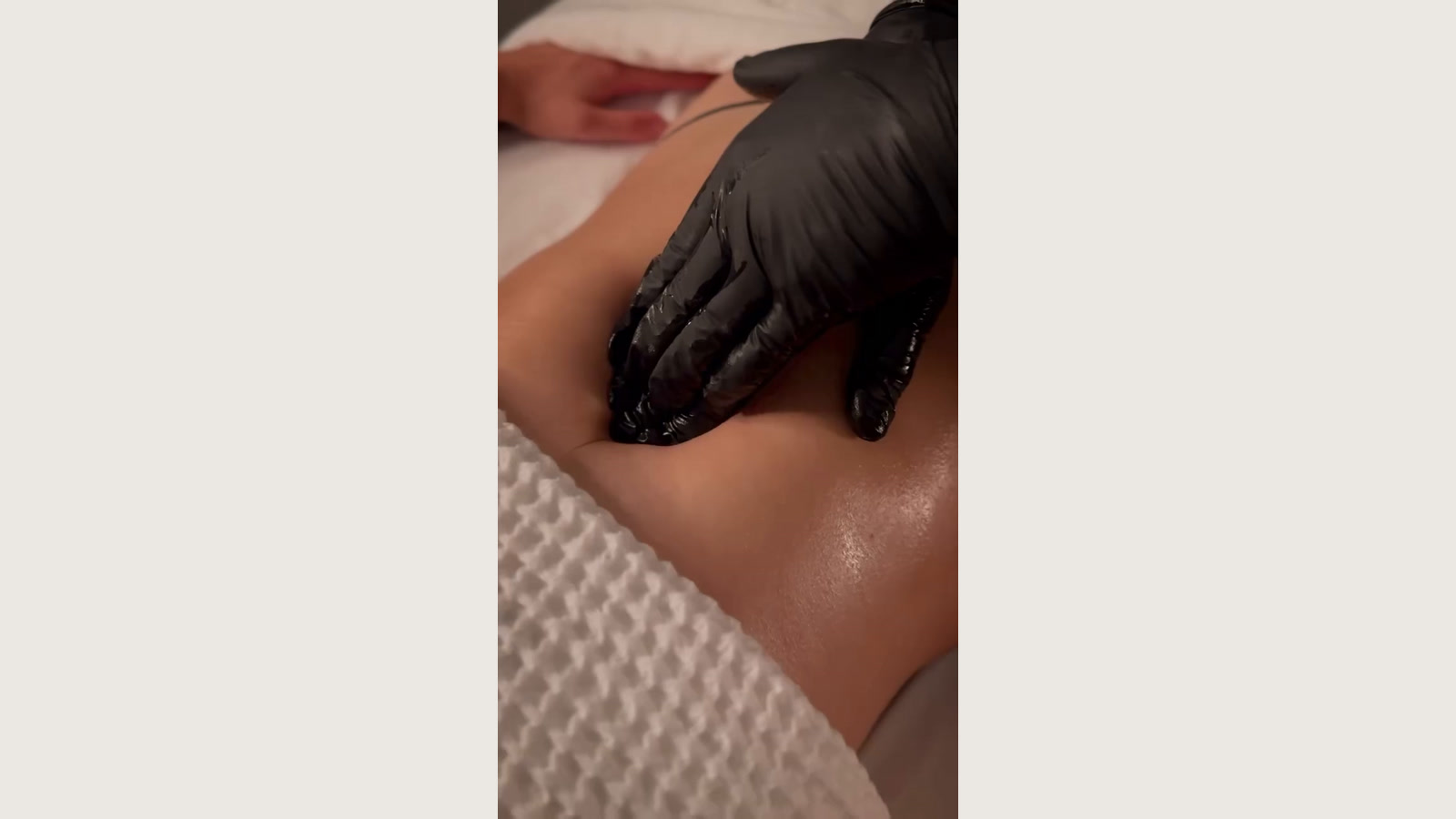
The belly is included in a lymphatic drainage session because it is one of the junctions fluid has to pass through on its way back toward the bloodstream — and because the abdomen is where a day's worth of retained fluid tends to show. At Lymphyx in Beverly Hills, Juanita Chabolla, licensed massage therapist and founder, works the abdomen with flat, light, slow strokes that move the skin and not the muscle beneath it. It is not a digestive remedy, and it is a different session from a colon massage. This is the longer version of a twenty-second reel she posted from the studio on Wilshire Boulevard.
The reel asks the question in its first line — "Why do we include the belly in a lymphatic massage?" — and answers it with a few facts about the lymphatic system of the gut. Some of those facts are well documented and worth explaining properly. Others we could not trace to a source we would link, so this post sorts them, says which is which, and then describes what the hands in the video are actually doing.
Why are your hands on my stomach when I booked for my legs?
Because drainage is sequential. Every session at the studio opens at the collarbones — the reason for that has its own Journal post — and then moves to the junctions nearer the trunk: light, rhythmic work near the armpits, the abdomen, and the groin. Those are the routes fluid passes through on its way up and out. Only after they have been worked do the hands go to the area you came in for. The abdomen is in the middle of that order on purpose. Skipping it would mean sending fluid from the lower body toward a stretch of the route nobody had prepared.
There is a second, plainer reason. The abdomen holds fluid and gas through the day, which is why a waistband is tighter at night than it was in the morning. That is also the part of the body most clients are thinking about when they book a wellness lymphatic massage, whether or not they say so on the form.
What is the gut's lymphatic system actually doing?
Two jobs, both well described in the physiology literature, and both more interesting than the usual one-line version.
It carries the fat you eat. Inside the villi that line the small intestine sit specialized lymphatic capillaries called lacteals. Most of the fat absorbed from a meal does not go straight into the blood. The cells of the intestinal wall package it into triglyceride-rich particles called chylomicrons, release them into the surrounding tissue, and the lacteals take them up into the lymph (Ann N Y Acad Sci, 2010; J Clin Invest, 1971). How quickly those particles move from the intestinal wall into the lymph depends on local lymph flow and on how hydrated the surrounding tissue is (Am J Physiol, 1985). So when the reel's caption says the lymphatic network in the gut "helps transport dietary fats," that is textbook physiology, not a slogan.
It is part of how the body watches what passes through the intestine. The wall of the gut carries its own lymphoid tissue — clusters of follicles, including the Peyer's patches — and specialized cells there, called M cells, sample material from inside the intestine and start immune responses to it (Mucosal Immunology, 2021; J Biochem, 2016). The mesenteric lymph nodes of the abdomen sit downstream of that tissue. That is the "role in immune defense" the caption mentions.
The reel and its caption also put numbers on how many lymph nodes sit in and around the intestines. We looked for a source for those figures that we could link beside the others, did not find one in this pass, and so the numbers are not repeated here. If we find the reference, it goes in. Until then, "the abdomen's mesenteric lymph nodes sit downstream of the gut's own immune tissue" is the sentence we can stand behind.
Does a light touch on the skin reach any of that?
No, and it is not trying to. This is the part a short video cannot say, so it is said here. Juanita's own description of the technique, from the caption, is exact: "we use light, rhythmic strokes to encourage lymph flow in the tissues just beneath the skin. That's why the pressure you see here is so gentle." Just beneath the skin is where the work happens. The lacteals are inside the intestinal wall and the mesenteric nodes are deep in the abdomen; flat hands moving skin are not pressing on either, and should not be.
We also looked for a study showing that surface drainage of the abdomen changes lymph flow in those deep vessels, and did not find one we could cite. So we do not promise that a session improves digestion, and we do not promise anything about immunity. What a session moves is retained fluid in the tissue near the surface — the same thing it moves at an ankle or along a jawline. If you want to know how to tell that kind of work from an ordinary massage sold under the same name, we wrote that up separately.
What does abdominal lymphatic drainage feel like?
Less than you expect. The hands lie flat, the strokes are slow and directional, and the skin is stretched rather than pressed. In the reel you can see the whole palm resting on the abdomen and the fingers barely indenting it. First-time clients often ask whether anything is happening. It is; lymphatic work is meant to feel like this everywhere on the body, and the abdomen is simply where the lightness is most surprising, because it is the place people brace for pressure.
You stay draped throughout: a towel above, the sheet below, and only the abdomen uncovered while it is being worked. Gloves go on before the first stroke.
Is this the same as a colon massage or a debloat session?
They are three different things, and it is worth knowing which one you are booking.
The abdominal step described here is a few minutes inside a full lymphatic drainage session — one stop on a route that covers the whole body. The colon cleanse massage is a separate sixty-minute session: a focused manual abdominal massage that follows the path of the large intestine, with a different purpose and a different kind of touch. It is not a colonic; there is no water and no equipment. And Detox & Debloat is the session built around the midsection for people who want that area to be the point of the hour rather than a step in it.
If you are not sure which fits, say what you are hoping to notice afterward when you book, and we will tell you which session that is — including when the honest answer is none of them.
When is the abdomen left alone?
After abdominal surgery — a tummy tuck or liposuction of the midsection, for example — the surgeon's plan decides when hands go near the area and how. That path begins with post-operative care, not with a wellness booking, and we follow the clearance you were given rather than our own calendar. Pregnant clients book after the first trimester with their OB's clearance. And abdominal pain, new or persistent bloating, or swelling you cannot explain is a question for your physician before it is an appointment with us.
Two practical notes from the studio's own FAQ: a light meal about two hours before a session is ideal, because a heavy meal within the hour makes abdominal work uncomfortable; and expect more trips to the bathroom for six to twelve hours afterward.
What the reel shows
Twenty seconds in the studio with a client who agreed to be filmed. Black gloves, a waffle towel folded across the chest, the sheet at the hips, and Juanita's hands working flat and slow across the abdomen from several angles; in one shot you see her leaning over the table, in the others only her hands. Lines of text fade in over the footage. The ones about dietary fat and immune tissue are the ones this post explains with sources; the ones about node counts and digestion are the ones it leaves out, for the reasons given above.
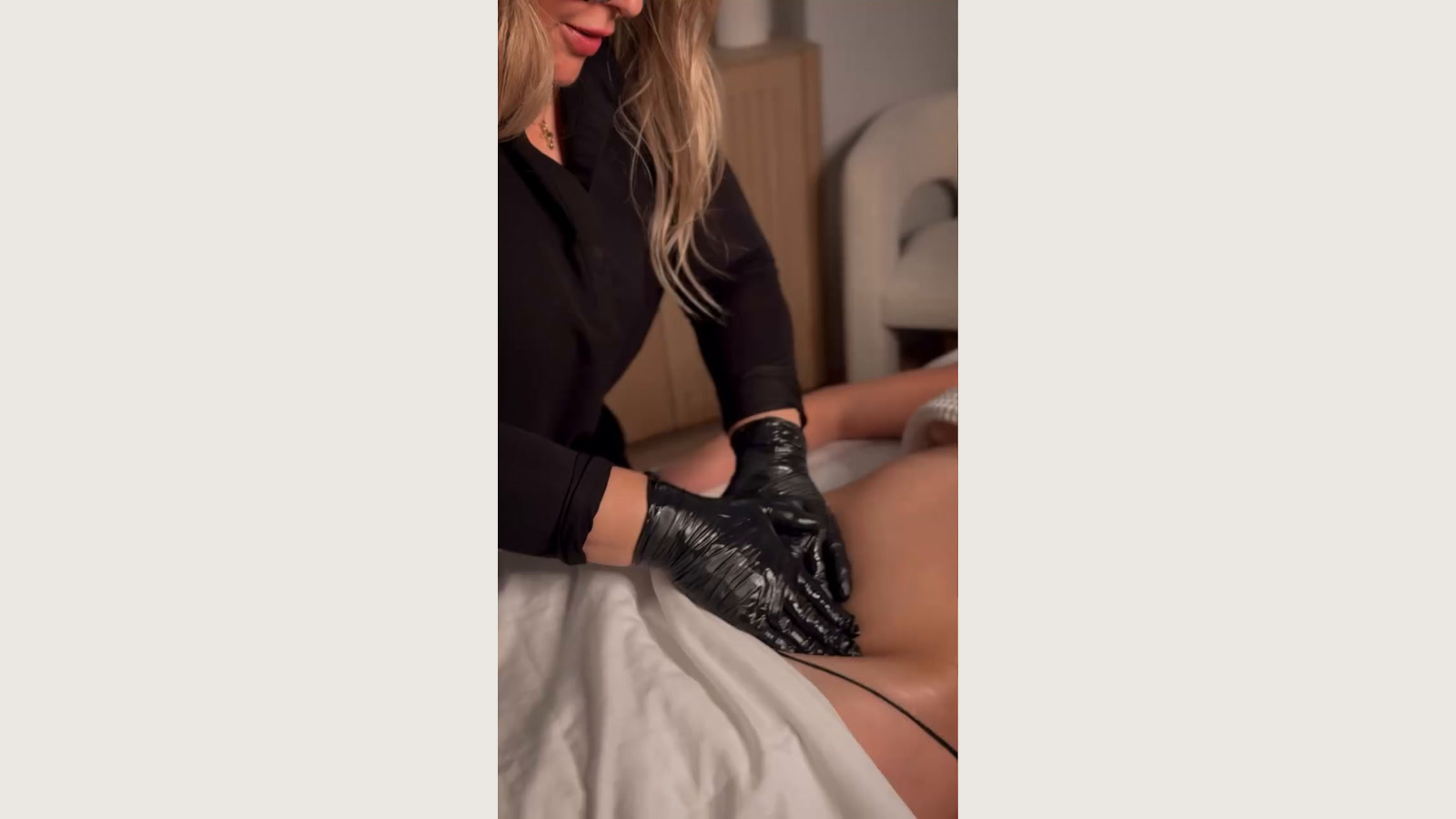 ▶ Watch the reel
Booking a session in Beverly Hills
Lymphatic drainage sessions run sixty, ninety, or one-hundred-twenty minutes, from $225, one client at a time, at 9150 Wilshire Boulevard in central Beverly Hills. Most of our regulars are Beverly Hills, West Hollywood, and Century City people who fit the hour into a workday, and the rest drive in from across the Westside of Los Angeles. The abdomen will be part of it, briefly and lightly, and now you know why.